
Urban ecosystems · planting and caring for trees
21 September, Tree Planting Day: planting a tree is only the beginning
Children in Petrinja watered trees already planted, while a report from Vrbovsko describes sowing tree seeds by drone. To mark 21 September, we explore what determines planting's long-term success after the initial action and why a new sapling is no substitute for caring for existing trees.
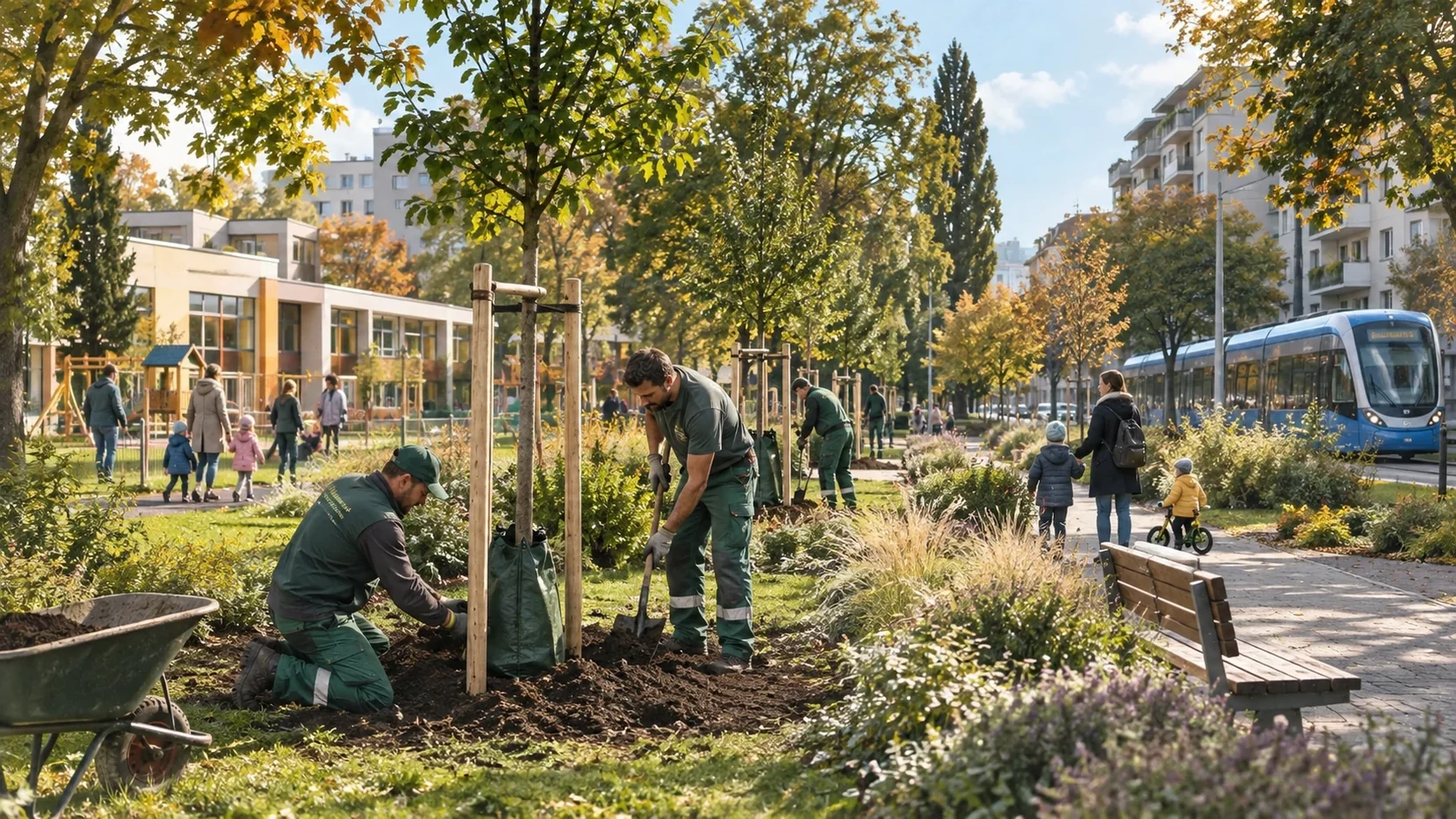
At the neighbourhood park beside the Izvor branch of Petrinjčica Kindergarten, the focus on 21 September was not on new trees but on those already growing there. Children from the Krijesnice and Pandice groups filled buckets using a hand pump and watered trees and other plants. According to the City of Petrinja's announcement of 21 September 2026, the activity was organised by the city's municipal services department. [1]
That small action raises a major question for every greening campaign: who returns to the tree after the group photograph is taken? The number of saplings planted tells us how much was done in the first step. Answering what we have gained in the long term requires a care plan, monitoring and preservation of what already exists. [5]
Care does not end on planting day
The Petrinja example is neither a report of new planting nor a measurement of the park's success. Its value is educational: children learned about caring for existing greenery through practical work and play. Maintenance is not an invisible add-on to an initiative, but an activity the community can understand and support. A single occasion of watering cannot, however, replace organised professional maintenance. [1]
A similar message, from a professional perspective, emerges from the conclusions of the “Planting on Hot Asphalt” discussion, held by UKAH in Zagreb on 12 March and published five days later. Participants stressed the need for regular irrigation in the first years after planting, an understanding of soil and microclimate, and sustained investment in the knowledge of people who maintain green spaces. These are the conclusions of a professional discussion, not research published today. [3]
The practical message for anyone organising planting is clear: alongside procuring saplings, decide in advance who will care for them, with what resources and how their condition will be checked. Such a plan is more than a final project item. It connects the initial planting decision with the place we want to have after several seasons. [3]
Water must reach the roots
Expert guidance from the University of Minnesota explains that newly planted trees need a regular water supply until their root systems become established. Water should be directed to the root zone, with moisture also available beyond the original root ball so that roots can spread. Mulch can help retain moisture and moderate fluctuations in soil temperature, but should not rest against the trunk. [4]
That guidance also contains numerical schedules suited to local conditions. We do not present them as a universal calendar for Croatian cities: the specific amount and frequency of watering require an assessment of the tree and its site. For residents wishing to help, an appropriate first step is to consult the green-space manager, rather than add water randomly or undertake work around the trunk. [3][4]
A drone can sow seeds; the outcome needs monitoring
HRT / Radio Rijeka reported on a different initiative in Vrbovsko on the same date. According to the report, drones dispersing balls containing tree seeds were used on land from which the City had previously provided firewood for families in need. Children also took part in the educational activities. Sowing is a more accurate description of this method than planting nursery-grown saplings. [2]
The report also includes contractor Project O2's estimates of the procedure's speed and cost. These are not independent confirmation of long-term success. Completed sowing, germination, the establishment of young trees and a restored forest are different stages. The news of the operation alone therefore cannot tell us how many trees survived. That conclusion would require follow-up data, which the report does not provide. [2]
More trees are not the goal in every habitat
In its initiative for three billion additional trees by 2030, the European Commission links planting with long-term planning and monitoring. The right species, location and purpose matter. It also warns that ecologically valuable open habitats, such as grasslands, peatlands and wetlands, should not be converted into planting areas merely to increase tree numbers. [5]
The Commission's second message is equally important: new planting does not replace the preservation of existing trees. These are not opposing goals. A city can seek space for new canopies while preserving the trees it already has. A commemorative planting day is an opportunity for both, not a reason to focus only on the new sapling. [5]
Zagreb: distinguishing archives, announcements and results
The City Assembly's announcement about Tree Planting Day, which provided the initial lead for this article, is dated 21 September 2024. The figure of eight thousand trees planted in that announcement does not refer to 2026. [6]
On 5 November 2025, the Zagreb Energy Centre announced a new season involving 8,015 trees at 1,317 locations. That announcement confirms a plan, not its full implementation. A responsible assessment should distinguish how many trees were announced, how many were planted and how they subsequently develop. The sources cited here contain no final verification of the survival of that group of trees. [7]
What should we ask before the next initiative?
We suggest four questions for organisers: why were that particular species and site selected; who will take responsibility for watering and other care; how will tree condition be recorded; and when will the results be available to the public? These are editorial suggestions for discussing project quality, not a list of universal legal obligations.
The occasion also offers an opportunity to clarify the dates. ENO Schoolnet states that it organised its first joint tree planting on 21 September 2004, the International Day of Peace. UNESCO presents 21 September as Peace Day; we do not attribute the proclamation of a separate Tree Planting Day to these sources. [8][9]
Planting a tree is an important beginning. The question that remains after the event is: who will care for it, and how will we know what has been achieved?
Sources and verification
The content and dates of the listed public sources have been checked. No field inspection or independent verification of long-term results was conducted. Other people's photographs and statements are not presented as our own materials.
- City of Petrinja · Krijesnice and Pandice become little guardians of nature ↗2026-09-21 · Original announcement by the organiser; a description of activities, not monitoring of tree survival.
- HRT / Radio Rijeka · Vrbovsko: new technologies for tree planting ↗2026-09-21 · News report by Nenad Lučić; a description of sowing and the contractor's statements, without confirmed long-term results.
- UKAH · Conclusions of the “Planting on Hot Asphalt” discussion ↗2026-03-17 · Conclusions from an expert discussion held on 12 March 2026; not new empirical research.
- University of Minnesota Extension · Watering newly planted trees and shrubs ↗Reviewed in 2026; publication date not stated. · Expert guidance marked as reviewed in 2026; we do not present Minnesota's numerical schedules as a prescription for Croatia.
- European Commission · 3 Billion Trees Initiative ↗Publication date not stated; accessed on 21 September 2026. · Guidance on location, species, monitoring and preservation of existing trees; not confirmation of any individual project.
- Zagreb City Assembly · International Tree Planting Day ↗2024-09-21 · Archive announcement from 2024; not this year's report.
- Zagreb Energy Centre · City of Zagreb launches a new planting season ↗2025-11-05 · Planting announcement; the 8,015 trees and 1,317 locations cited in that announcement do not prove completion.
- ENO Schoolnet · ENO Tree Planting Days ↗Publication date not stated; accessed 21. 9. 2026. · History of the initiative and the choice of date; not a UNESCO decision proclaiming the day.
- UNESCO · International Day of Peace ↗Publication date not stated; accessed on 21 September 2026. · Confirms that 21 September is the International Day of Peace.
Related articles

Since 30 July, we have been living on ecological debt
On 30 July, humanity used up the natural budget that can regenerate over the whole of 2026. Since that date, we have been living by depleting natural capital and accumulating waste, chiefly carbon dioxide in the atmosphere.

The Bijela River flows freely again after eight barriers are removed
Removing the last of eight barriers on the Bijela River, an important tributary of the Plitvice Lakes, restored its free flow and improved conditions for river biodiversity and the return of the Danube salmon.
August 2026 equals the global temperature record
August's global average air temperature was 16.96°C, tying with July 2023 as the hottest month on record, according to Copernicus data reported by Reuters.