
LAW AND ENVIRONMENT · REGULATION (EU) 2024/1991
Nature restoration in Croatia: what do the new rules mean for mature trees?
European rules link urban ecosystem restoration with the preservation of green spaces and tree canopy cover. Croatia's implementing act assigns responsibilities, while professionally justified transplanting of mature trees is also emerging as a possible instrument. [1]

AI illustration: Ekologija.hr. It does not depict a specific location or intervention.
Regulation (EU) 2024/1991 on nature restoration has been in force since 18 August 2024 and applies directly in Member States. Article 8 is particularly important for cities, setting targets for urban green spaces and tree canopy cover. [2]
Croatia's Act Implementing the Regulation was published on 29 June 2026 in Narodne novine, No. 69/2026. It specifies the competent authorities, preparation of the National Nature Restoration Plan, indicator monitoring and implementation reporting. [3]
The Regulation does not introduce a general ban on felling, a uniform replacement planting ratio or an obligation to transplant every tree. For urban ecosystems, it sets outcomes that Member States must achieve. [4]
The Regulation prescribes an outcome
By 31 December 2030, there must be no net loss of urban green space or tree canopy cover at the overall national level within designated urban ecosystem areas, compared with 2024. [1]
From 2031, an increasing trend in urban green space is required at national level, and in tree canopy cover in each designated urban ecosystem area, until satisfactory levels are reached. [1]
Note on scope: when calculating the 2030 target, a country may exclude areas that simultaneously meet both conditions: more than 45% urban green space in urban centres and clusters, and more than 10% tree canopy cover. [1]
These are therefore indicators within a defined spatial area, not the same rule for every individual tree.
The Croatian framework: from spatial planning to monitoring
Article 5, paragraph 6 of Croatia's implementing act assigns the authority responsible for spatial planning the task of improving the legislative framework to prevent net losses of urban green space and tree canopy cover, and to encourage and measure their increase. The same authority defines urban ecosystem areas, coordinates their mapping and ensures that urban indicators are monitored. [3]
Specific measures are being developed through the National Nature Restoration Plan and related implementation instruments. This also raises the question of how to handle existing mature trees at sites of planned interventions. [5]
A mature tree and a new sapling are not the same
One mature tree removed and one newly planted sapling may numerically represent a “one-for-one” replacement, but equal numbers do not mean equal canopy cover.
A sapling's canopy has yet to develop. The number of trees planted therefore does not by itself prove that the lost canopy area has been replaced — an indicator the Regulation monitors separately. [4]
This raises the question of whether, before removing a healthy mature tree, it is possible to explore preservation in its current location, adapting the project or professional transplanting.
This sequence is not prescribed as a universal obligation by either the Regulation or Croatia's implementing law. It represents a possible framework for considering alternatives, not a description of an already mandatory procedure. [4]
Transplantation as a possible tool, subject to expert assessment
European legal systems already have different approaches to regulating transplantation.
In the Autonomous Community of Madrid, regional Law 8/2005 provides for transplanting covered urban trees that are necessarily affected by certain works. Where felling is pursued as the only viable alternative, a competent expert must confirm that transplanting is not feasible, with the statutory exceptions applied. [6]
Poland's Nature Conservation Act allows removal permits to be conditional on transplanting or replacement planting. Assessing transplantation involves considering the new location, the size of the root ball, the shape of the root system, the tree's condition and the preparation time required. [7]
The Sofia example, considered in a March 2024 decision by its Administrative Court, illustrates the importance of records, expert opinions and written permission. These are distinct legal mechanisms and should not be equated with a general obligation to transplant.
Rules governing these procedures existed before the 2024 Regulation. They are not proof that it mandates transplantation, but examples of how transplantation can be regulated by law. [6]
Transplanting is not suitable for every tree. Its feasibility and outcome depend on species, health, the root system, the new location, preparation for the intervention, subsequent care and monitoring of recovery. A legal decision therefore cannot replace an expert arboricultural assessment. [7]
How will implementation be measured?
Member States must monitor urban green spaces and tree canopy cover at least every six years. The Regulation provides for electronic databases and geographic information systems, with the widest possible use of remote sensing, Copernicus data and field data. Monitoring results must be published. [4]
Countries must submit a more detailed report on implementation and monitoring results for the period up to 2030 to the Commission by 30 June 2031, and at least every six years thereafter. [4]
This means it will not be enough to state how many trees have been planted. Achievement of the targets must be demonstrated through measurable changes in space.
What is monitored in urban ecosystems?
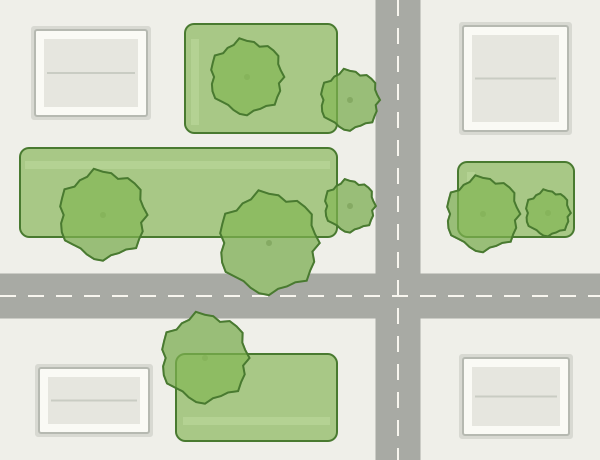
Urban green spaces
Tree canopy cover
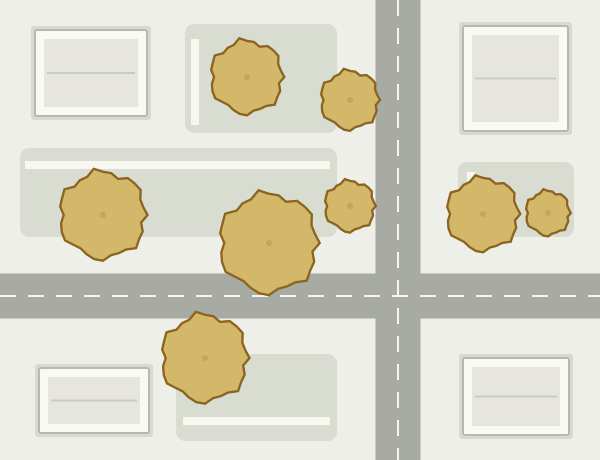
The number of trees alone does not show how much area their canopies cover. Green spaces and tree canopy cover are monitored separately.
A schematic illustration. Not an official methodology or a measurement of a specific site. Tree canopy cover is not the same as a tree's shade.What if the measures are not enough?
If monitoring shows that the measures will not be sufficient to meet the obligations, the national plan must be reviewed and supplemented if necessary. After consulting the country, the Commission may request a revised draft containing additional measures. [4]
There is also a general infringement procedure for breaches of EU law, which the Commission may initiate and refer to the Court of Justice of the European Union. If a country does not comply with a judgment, financial penalties may be imposed in further proceedings. This is not an automatic fine for each tree removed, but state responsibility for failing to fulfil legal obligations. [8]
What comes next in Croatia's implementation?
Croatian law defines responsibilities, monitoring and improvements to the legislative framework for spatial planning. The national plan and related instruments should specify the measures through which the targets will be achieved. [5]
Possible measures include protecting existing trees during design and construction, replacement planting, increasing green spaces and transplanting where professionally justified. Their contribution comes not just from carrying out the intervention, but from what it actually preserves.
The Regulation does not prescribe every individual tree decision for Croatia, but it does prescribe the outcome that will be measured.
Alongside the question of whether a particular tree may be removed, a broader question therefore arises:
What is the cumulative impact of such decisions on the urban greenery and tree canopy cover that Croatia is required to preserve and increase?
Note on sources Alongside the legal analysis
The Sofia example: the supplied text does not provide a case number or direct link for the Administrative Court decision of March 2024 mentioned above. This example has therefore not been independently verified against a specific court reference.
Responsibilities under Croatian law: alongside Article 5, paragraph 6, the designation and mapping of areas under Article 6, paragraph 3 must be distinguished from responsibility for monitoring under Article 9, paragraph 4. Open the cited source.
The author's text is reproduced without substantive changes. This note remains separate from the author's text.
Sources for the article
Links are taken from the supplied text. Numbers in the article lead to the corresponding source.
- 01
- 02The EU #NatureRestoration Law ↗Environment
- 03
- 04
- 05
- 06
- 07Legal act ↗European Legislation Identifier
- 08Financial sanctions - European Commission ↗European Commission
Related reading
 URBAN ECOSYSTEMS · FRAN POŠTENJAKCroatian expert warns: If we lose urban trees, Croatian cities will become concrete ovensOpen the published article →