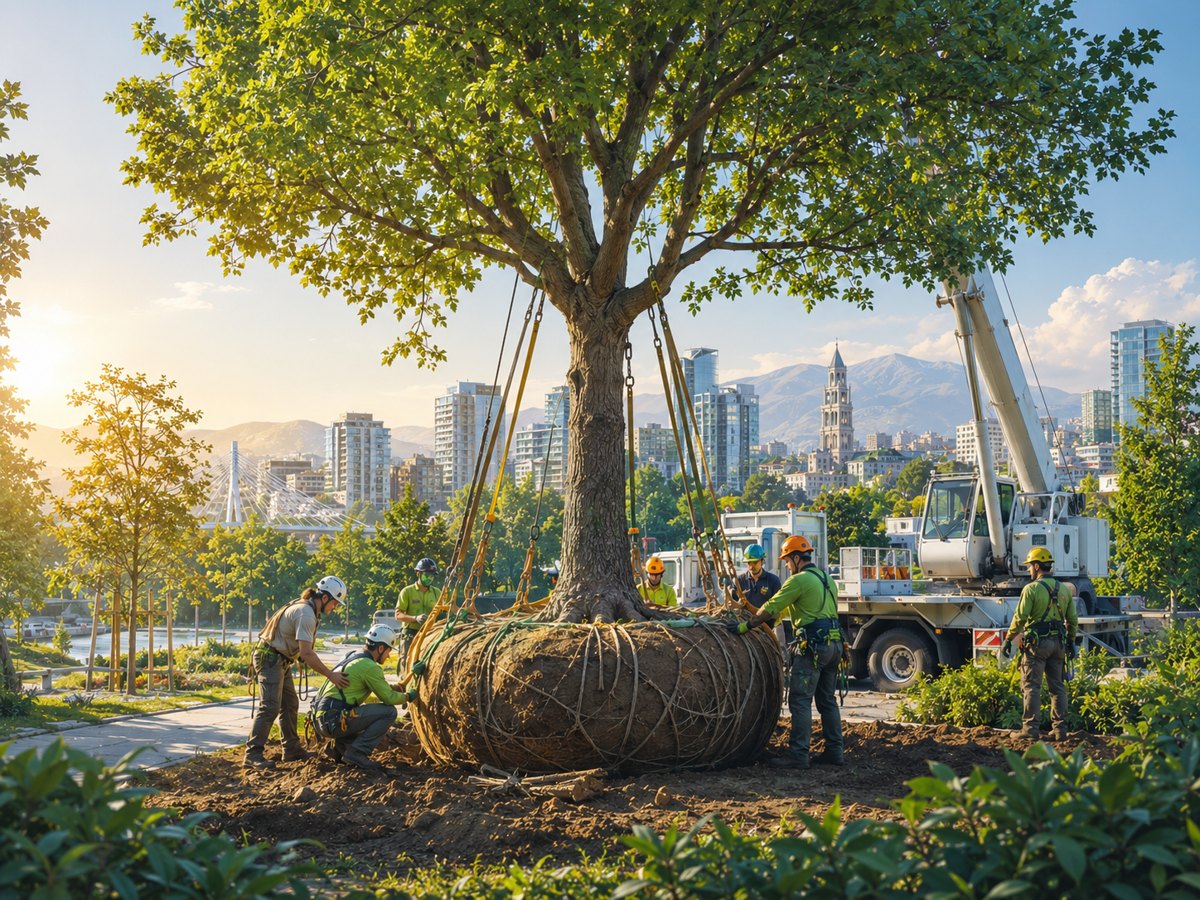

Relocating a mature tree can be a valuable option when preservation in place is not feasible, but it is not an automatic answer to a conflict between trees and construction. The decision must precede the choice of machinery — through assessment of the tree, project, roots, new location, risks and long-term commitments.
Key points
- Preserving a valuable tree in its existing location takes priority where professionally and technically feasible within the project.
- Relocation begins by assessing the tree and the new site, not by choosing a machine.
- The end of transport marks the start of the rooting period; success is assessed over years.
The sequence of a responsible decision
- Preserve in place. Check whether a healthy tree can remain in place with its canopy, trunk, roots and soil protected.
- Adapt the project. Change the route, foundation, elevation, construction access or layout where reasonably feasible.
- Consider relocation. Only when preservation in place is not feasible and an independent assessment finds an acceptable biological, technical and spatial basis.
- Justify removal. If the first three options are not justified, the decision must clearly present the reasons and a plan for replacement value.
This sequence does not mean that every tree can or should be preserved. Health, structural stability, species, location and future conditions must be assessed individually. Particularly valuable, old or veteran trees support ecological relationships that physical relocation alone may not necessarily transfer.
The decision does not start with a machine
There is no single formula or credible universal success rate for large trees. Assessment must connect tree biology, root distribution, soil properties, machinery access, transport distance, the destination site, season, logistics and a care plan.
Species, dimensions, vitality, structural safety, expected lifespan and ecological value.
Root distribution, obstacles, soil, drainage and the possible shape of the root ball.
Access, lifting, weight, route, infrastructure, permits and the safety of everyone involved.
Soil volume and quality, water, anchoring, canopy space and long-term compatibility.
Relocation is a multi-year process
1. Preparation
An inventory and expert inspection, trial excavations, a root plan, mass assessment, possible phased preparation and a destination site prepared in advance. The project must define responsibilities, deadlines, risks and criteria for abandoning the operation if investigations reveal unacceptable conditions.
2. Implementation
Protection of the trunk, canopy and root ball; controlled lifting and transport; correct planting depth; good contact between roots and surrounding soil; stabilisation; and documentation of each key stage. Canopy pruning is not an automatic substitute for lost roots; its extent must follow an expert assessment.
3. Root establishment
Irrigation based on actual soil moisture, mulching, stability checks, health inspections and adjustments to care. In its early years, a tree may survive while gradually losing vitality, so a single green leaf or the first growing season is not sufficient proof of success.
What does success mean?
Criteria must be agreed before the intervention and monitored over comparable periods. For trees of public importance, the initial assessment, reason for the decision, methodology, responsible experts, care plan and monitoring results should be published.
- survival and structural safety;
- gradual recovery of canopy density and function;
- development of new shoots and roots;
- absence of progressive dieback;
- a stable water regime, aeration and soil condition;
- recorded inspections, interventions, costs and deviations;
- the outcome after predefined periods, not just the first season.
What does Arbora bring to this topic?
As the topic's initiator, Arbora is developing a process connecting expert assessment, technical planning, specialised machinery, logistics, preparation of the destination site and aftercare. The proposed schedule of checks at 3, 6 and 12 months, followed by monitoring over 2 to 5 years, treats relocation as a commitment to a living system rather than a one-off demonstration.
Biological outcomes cannot be guaranteed in advance. A contractor can define the methodology contractually, demonstrate qualifications, maintain records and undertake care and response obligations when indicators signal a problem.
Arbora provides services related to tree preservation and relocation and has a direct professional and commercial interest in the topic. Ekologija.hr independently selects sources, includes other perspectives and decides on conclusions and publication.
Relocation is no excuse for poor planning
The technical possibility of relocation must not weaken the obligation to preserve trees early in the design process. When a transparent assessment finds that relocation is the best remaining option, quality is demonstrated through preparation, the choice of the new location, care and publicly available results — not just an impressive day of transport.